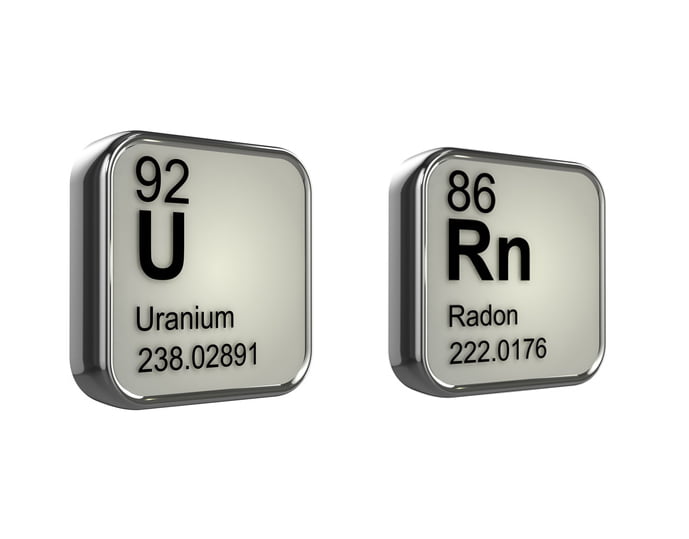
Treatment of Radon and Uranium in Water

In the Outaouais region, but more specifically in Chelsea and Cantley, the composition of the subsoil means that some homes are affected by excessive concentrations of radon and uranium.

The Radon gas

The main source of infiltration of this radioactive gas is through cracks in your home’s foundation. The concentration of this gas can be easily measured by ordering an analysis kit. The sampling method is available via Health Canada’s link at http://www.hc-sc.gc.ca/ewh-semt/pubs/radiation/radon_homes-maisons/index-fra.php.

The main source of this radioactive gas entering your home is through cracks in the foundation. The concentration of this gas can be easily measured using an analysis kit. The sampling method can be found at the Health Canada link at http://www.hc-sc.gc.ca/ewh-semt/pubs/radiation/radon_homes-maisons/index-fra.php.

Fortunately, radon is easy to treat in water, provided you have the right equipment. We distribute radon treatment equipment that can easily treat 99% of the radon in your water (at a maximum flow rate of 7 US gallons per minute). If a higher flow rate is required, we also offer equipment that can treat up to 14 US gallons per minute and has a radon removal rate of 98%.

For a quote, nothing could be simpler: contact us by clicking here. We will get back to you within 24 hours.

The Uranium

Uranium can be effectively removed using an ion exchanger. The uranium ion is captured by the exchanger media and released with the wash water during regeneration of the device. We offer a choice of several ion exchanger sizes depending on your flow rate requirements. These relatively simple devices require no more maintenance than a water softener.

Frequently Asked Questions (FAQ)

  • Radon: A naturally occurring radioactive gas that can dissolve in groundwater from the breakdown of uranium in soil or rock.
  • Uranium: A radioactive heavy metal that occurs naturally in some groundwater, especially in granite or shale regions such as those found in parts of the Outaouais and Nova Scotia.
  • Radon: Inhaling radon released into the air by water can increase the risk of lung cancer. Prolonged ingestion can have lesser side effects.
  • Uranium: Long-term exposure can cause kidney damage due to its chemical toxicity, in addition to risks related to its radioactivity.
  • Uranium: Limit of 0.02 mg/L (20 µg/L) according to Health Canada.
  • Radon: No federal standard for drinking water, but Health Canada recommends mitigation measures if the water releases radon into the air above 200 Bq/m³.
  • Uranium: A chemical test carried out by an accredited laboratory.
  • Radon: Specific laboratory analysis to measure its concentration in water.
  • Ventilation: Use a specialized ventilation system to remove radon before the water enters your home.
  • Activated carbon: Activated carbon filters can absorb some of the radon, although we do not recommend this approach.

Contact us for proven solutions!

  • Reverse osmosis: Very effective at reducing uranium and approximately 95% of water contaminants
  • Ion exchange: Some ion exchange systems can also reduce uranium concentrations. These systems use salt as a regenerant, just like a water softener.

Contact information

Any questions? Need a system or analysis? Write to us, we will be happy to answer you.